Crying
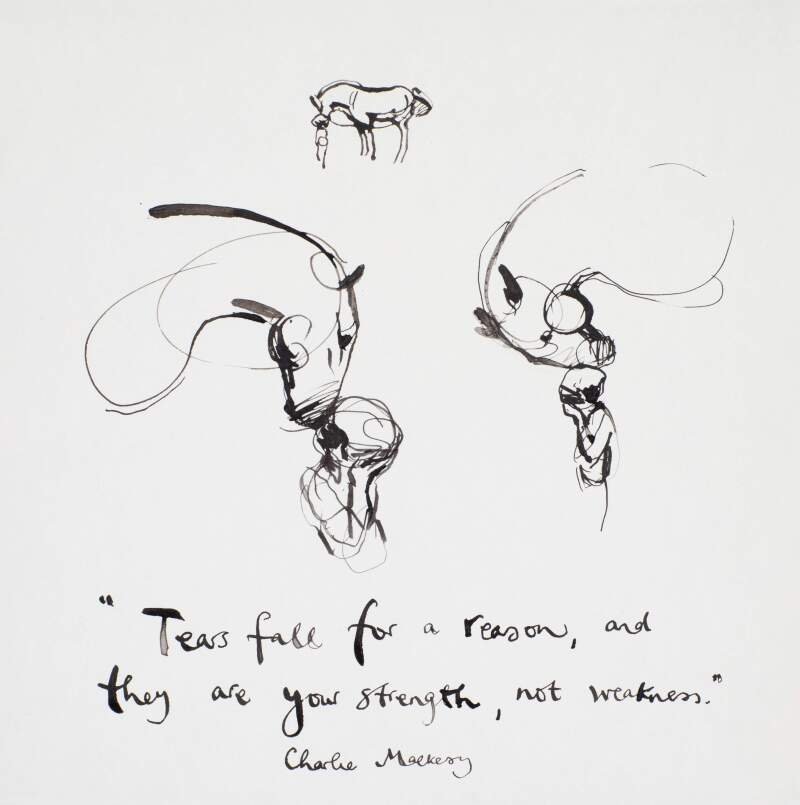
The Boy, the Mole, the Fox, and the Horse by Charlie Mackesy
I pressed “Start” to initiate the meeting. My colleagues appeared on the screen one by one, mugs in hand, ready for our monthly Sip & Share, a professional peer group where we explore the challenges and triumphs of our careers and lives. The format is simple: I introduce a theme, offer a few prompts, and we discuss.
But that day, I couldn’t follow the script.
The moment their beautiful faces appeared, my throat clenched shut. My swollen eyes pooled instantly as a twenty-pound weight settled on my chest. I knew the override button for my body was nowhere to be found. So I surrendered to the only option left. I invited my grief and then,
I wept in front of all my colleagues.
The day before, our puppy Squish had passed away after a month-long journey that started in a veterinary emergency room when he experienced his first severe bout of respiratory distress caused by an underlying heart condition. As our hands pressed against the glass of the oxygen chamber holding our first family pet, the reality of the inevitable settled over us. It was the beginning of the end; he had only weeks left to live. Tears rolled down all our faces until my son, William, broke the silence.
“Why do humans cry?”
My husband, Eric, answered softly: “Since emotions are invisible but can cause so much pain, maybe crying is a way for our bodies to communicate to our community that we are in distress so we can receive support from the people who love us.” (It turns out that Eric’s guess was consistent with the research).
Later that night, lying in bed with Squish pressed against my leg, I reflected on William’s question and on the messaging surrounding this uniquely human behavior.
“Don’t be such a crybaby.”
“Real men don’t cry.”
“Stop crying or I’ll give you something to cry about.”
“Big girls don’t cry.”
These are the phrases we grew up with and the lyrics that topped the charts. Although it completely contradicts our evolutionary biology, the messaging is clear: crying is synonymous with weakness.
Our behavior reflects it too. When tears come, we cover our faces, turn away, apologize. Even in tender moments, when someone bravely shares their vulnerability, we instinctively say, “Don’t cry.”
I began wondering: what if we challenge this script? What might we gain if we trust our body’s natural response to grief?
I posed the question to the ether and fell asleep. That night, I dreamt I was in a breathwork class with a friend who is a free diver. With each inhale, she coached me to gently expand my lungs beyond what felt comfortable, like blowing up a balloon to the point just before it pops. The tension in my chest was uncomfortable and scary, but I could feel it working. With every breath, my capacity increased. Then, as dreams often do, the metaphor revealed itself:
My grief, not my inhale, was the agent for expansion. And the purpose of this newly earned spaciousness? To hold love.
Perhaps no one says it better than Khalil Gibran in The Prophet’s chapter On Joy and Sorrow: “The deeper that sorrow carves into your being, the more joy you can contain.” Such beautiful poetry. But embodying these words is something else entirely.
Thankfully, I have role models. With their permission, I share their wisdom:
Eric
When the pandemic hit, my husband’s vocation shifted dramatically from being an internal medicine doctor to being an usher. Day after day, he’d go to the hospital and, instead of treating and curing, he’d be alone in a room with a person for whom all he could offer was a witnessed death. He’d turn up the volume on an iPad so the patient could hear Ava Maria being played by volunteer musicians. He’d gently place his gloved hand on a body no one else could touch as family members said their goodbyes from another iPad. When this makeshift funeral ended, he would sit alone with the person until their spirit crossed the threshold.
Then he came home.
One night, when I asked how I could support him, he simply said, “I’m just so sad.” After the kids were asleep, we sat together on the couch. There was nothing to fix. Nothing to solve. He rested his head on my lap and wept. He cried for his patients, their families, and the helplessness of being unable to do the job he had spent years training for.
This became our sacred ritual. It didn’t happen often, but we relied on it when needed. We’d meet on the couch and let grief move through. No speeches. No silver linings. Just tears carrying unbearable sorrow out into the wide open air.
I often wonder what our life would be like if he didn’t allow those tears to move through him.

Dr. Eric, VA Hospital, Denver, 2020
Violetta
I’m blessed to live ten feet south of a remarkable woman and bestie whose fierceness rivals her humor. During a recent walk together, I casually asked how she was doing. She stopped mid-step and inhaled deeply. The energy shifted instantly. You know the vibe. The unmistakable moment when the conversation shifts as grief arrives on the scene from someplace ancient and unexpected. I braced for the usual: an apology or “I told myself I wouldn’t cry”.
But instead, she placed one hand on her chest and lifted the other gently toward me, like a crossing guard stopping traffic to safely escort school children across the street. Then she said: “Just a minute: I’m inviting it.”
I’m inviting it.
She really was a crossing guard. She wasn’t abandoning her grief. She was safely escorting it into the open.
What followed was beautiful. She wept unapologetically while telling stories about her late mother, Mira, and her recently passed dog, Roscoe. She had invited her grief and we welcomed it wholeheartedly. There were no tissues. No attempts to shut it down. Just tears, laughter, memory, long exhales and a deeper friendship because of it.
Back in my Sip & Share meeting, after the first wave of sobs passed, I finally looked up at the screen.
I saw an entire gallery of colleagues leaning closer to their screens. They were leaning into my grief. Cameras were turning on. People’s hands were on their hearts. No one was uncomfortably looking away. No one was telling me I was being unprofessional.
It became one of the most profound professional experiences of my life. The moment I let my guard down, something deeper emerged: connection, healing, and the reminder that the act of crying is not an interruption to our humanity or our work, it is evidence of it.

Squish, our jungle pug who loved chasing hermit crabs in Costa Rica
Reflection prompts for our collective
What messages about crying or emotional expression did I inherit growing up?
When was the last time I allowed myself to fully “invite” grief instead of suppress it?
Who has modeled healthy emotional honesty for me?
What changes in my relationships when I/we stop trying to fix pain and simply witness it?
What might become possible if I treated my tears not as weakness, but as a strength, a form of communication and a means of connection?
Thanks for being here friends. Thanks for helping us give Squish such a great life. Thanks for showing up for your friends in grief and for having the bravery to cry in front of someone you trust. And thank you, to my incredible Sip & Share colleagues, for leaning in when I needed it.
If you feel called to share this issue with others and help us grow The Collective, we’d be honored. If you have a story to share or want your tears to be seen, we welcome your comments below.
Much, much Love!
Daniela
Daniela Young
Founder, The Ōnda Collective