Ring Theory
True to form, I had given myself exactly 15 minutes to get ready for my daughter's 8th grade graduation ceremony.
She was already on a school bus with her classmates of nine years, en route to the venue, feeling so proud and looking so confident. Immediately following graduation, her entire class would depart for a two-week immersion experience in Spain before going their separate ways for high school. Oh, and it was her birthday. So many big events and emotions in one day.
Meanwhile, I was on track to pull myself together and make it to the ceremony on time until a massive glitch interrupted my plan: my curling iron was missing. I quickly realized that my daughter had loaned it to a friend and hadn't returned it as promised. I instinctively grabbed my phone and started texting: Where is my curling iron?! Thank goodness the spell lifted before I pressed send.
Because this was her day.
In retrospect, I see that being annoyed about the hair tool was just easier and faster than leaning into what was really happening for me: My baby was growing up. And with her transition, my role as her mother was also changing.
What stopped me from sending that sabotaging text was a sense that the order of things was off. My feelings were real, even if they were expressing themselves through the petty lens of a curling iron. But they didn't belong in the center of my daughter's special day.
There's a framework that helps make sense of this. It's called Ring Theory.
Ring Theory was described by psychologist Susan Silk and mediator Barry Goldman in their Los Angeles Times article, "How Not to Say the Wrong Thing."
The idea emerged from Susan's own experience as a breast cancer patient. A colleague was insistent on visiting her in the hospital. When Susan explained that she wasn't taking visitors, the colleague was offended and replied, "This isn't just about you, Susan!" Susan's internal response: Oh yes, it is.
And she was right.
Ring Theory is a simple way of thinking about how support can flow during times of crisis, grief, loss, and trauma. I would also argue that it also applies to celebrations and transitions.
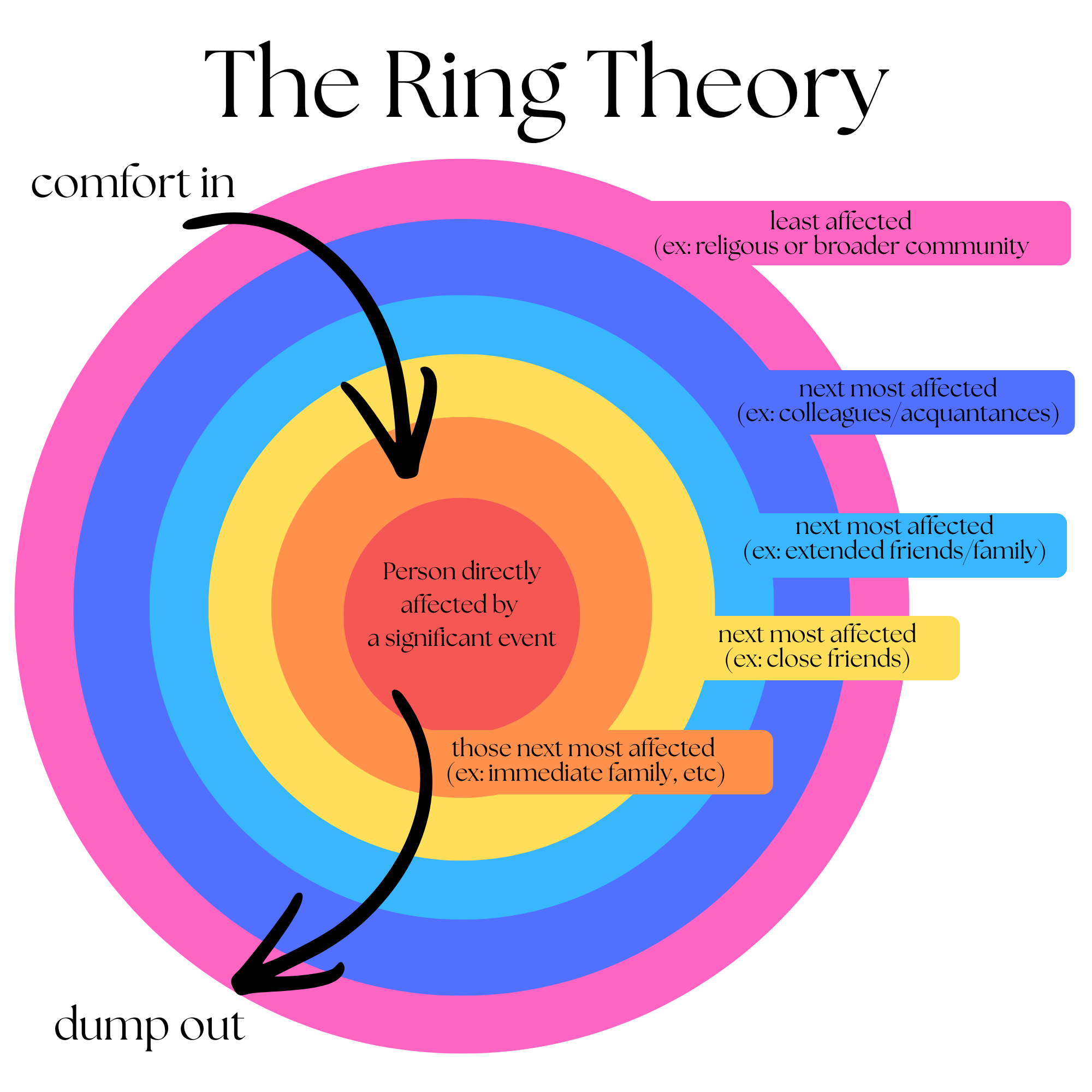
Setting up the rings
Imagine a series of concentric circles.
In the center circle is the event and the person or people most directly affected by it.
The next circle includes the people next most affected - usually immediate family.
The next circle might include best friends or extended relatives.
Then colleagues, more distant family friends, acquaintances, and the broader community.
The farther you move from the center, the less directly you are affected.
This is where the theory becomes especially useful:
Comfort In, Dump Out.
Susan and Barry describe two directions in which support can flow among the rings. You are either in a position to receive or a position to give. They call this "Comfort in" and "Dump out."
If someone is in a circle closer to the center than you, your job is to provide "comfort in."
Listen. Offer support. Ask what they need. Help without making yourself the center of the story.
It does not mean offering unsolicited advice, inviting yourself into their space, or expecting the person at the center to take care of your feelings.
If someone is in a circle further out than you, you get to "dump out" to them.
Lean on them. Cry. Complain. Vent. Ask for help. Celebrate. As petty as it seems, you can even say, "I am so annoyed about this damn curling iron."
It is not your responsibility to support them. That is what their outer rings are for.
When we reverse the order, relationships falter. It feels painful. We've all seen it and we've all taken part.
It's the single bridesmaid who creates drama on her friend's wedding day.
The bereaved grandparent who goes to their child for emotional support when their child is the one who just experienced the stillbirth.
The friend who tells his terminally ill buddy how devastated he will be when his friend dies.
Or, in my case, the mother who nearly sends a snarky text about a missing curling iron to her daughter on her graduation day.
In these examples, the feelings and the need for support are not wrong. It is the direction that's off. An important thing to note here… if you are not at the center, it does not mean you do not need or deserve support! Just make sure you’re looking outward for it.
Everyone is going through something.
We all need support and we all have a capacity to give. Some of us are standing in the center of something right now. Some of us are one ring out. And some of us, by virtue of our professions, have stood in the outer ring for countless people for countless years.
Sometimes we get our rings mixed up. We ask the person in the center to comfort us. We forget to lean on our own people. When that happens, the framework can be a tool. Simply ask the question: Am I comforting in, or am I dumping out?
That tiny pause can change everything.
Back to the bathroom mirror
I deleted the text and messaged my girlfriend instead. I told her about the curling iron. That graduation was within the hour. That my daughter would be on a plane to Spain in a few hours. She didn't fix anything. She didn't give me advice. She just said, "That sucks. Today is hard." That was it. And that was all I needed.
She was standing one ring out, supporting me so I could support my daughter.
The graduation was spectacular. And my hair was... who even cares?
A few things to sit with
Are you standing in a ring right now? If anyone is more proximal than you, how can you comfort them? Who in your outer ring will you lean on for your own support?
Who are your trusted "dump out" people? Do they know?
Can you think of a situation in which someone in an outer ring “dumped in” on you? Is the theory helping you make sense of the confusing or painful feelings that resulted?
When have you done it to someone else, without meaning to? Is there any repair you could offer them?
Tell us your story
We'd love to hear from you in the comments.
Tell us about the time someone showed up exactly right. Or the time the rings got crossed and everything felt off (we could learn from this!)
Sometimes the person who needs to hear your story is standing just one ring away.
If you enjoy The Current, it would mean so much if you shared it with a friend. They can join our community for free here:
Missed an issue? Want to revisit a topic?
The Current, Issue V2.I6