Animism
How the theft of our car led me to meaning
A few days ago, life delivered an unexpected glitch in the matrix: our car was stolen.
My husband had just finished loading my parents’ luggage for an early-morning airport drop-off after a joyous Thanksgiving week. The car sat warming in front of the house while everyone stepped inside to grab a coffee and savor one last grandkid embrace. In that sliver of time, someone who’d been lurking nearby slipped into our car and simply drove away.
That moment set off a ripple of other events. The first of which was an unexpected extra dose of time with my parents: immediately after the robbery, realizing they still had their phones and IDs, we decided to make their flight. We shifted the plan and I drove so my husband could meet with the police. Because I see my aging parents only a few times a year, I deliberately savor our final moment together. I hover while feeling the scruff of my dad’s cheek and the warmth of my mother’s last embrace. This time, I lingered as I watched them disappear into the airport, so out of place without any luggage, but so at home holding one another’s hands.
The need to itemize everything inside the car soon followed. In the end, all items of value were stolen (except my son’s Kindle… apparently the thieves aren’t big readers!). Computers, wrapped Christmas gifts, jewelry, even dirty laundry transferred possession in that split moment. However, what didn’t vanish was the precious box of family Christmas ornaments my parents had decided to leave with me. We found ourselves saying, “Thank goodness they didn’t take the ornaments,” and even, “At least we can replace the computers.”
You all know me… such a big glitch doesn’t come without asking the deeper questions. “How can I remain open in a situation that easily ignites anger and narrow-focused thinking?” “What wisdom is asking to be revealed?”
I began reflecting on what our material possessions mean to us, and also, what they don’t mean. This sparked a revisitation of the notion of animism - the belief that things (plants, rocks, my kids’ lovies, our family ornaments) are not mere matter but have the possibility to possess spirit. Rooted in the Latin anima, meaning “soul,” animism is practiced widely among Indigenous cultures and echoes through Zen Buddhism’s “Sermon of the Inanimate”, which teaches that all things express the interconnectedness of reality simply by being.
My family first encountered the concept of animism while watching a film about a village in the South American country Suriname, where the guide described the tribe’s belief that everything, including trees, soil, animals, and the village’s statues, had a soul. Shortly after, my son William, then five, built a Lego statue to honor this concept that resonated so deeply within him. He gifted the statue to me and it remains a deeply cherished chunk of plastic that lives on my altar.
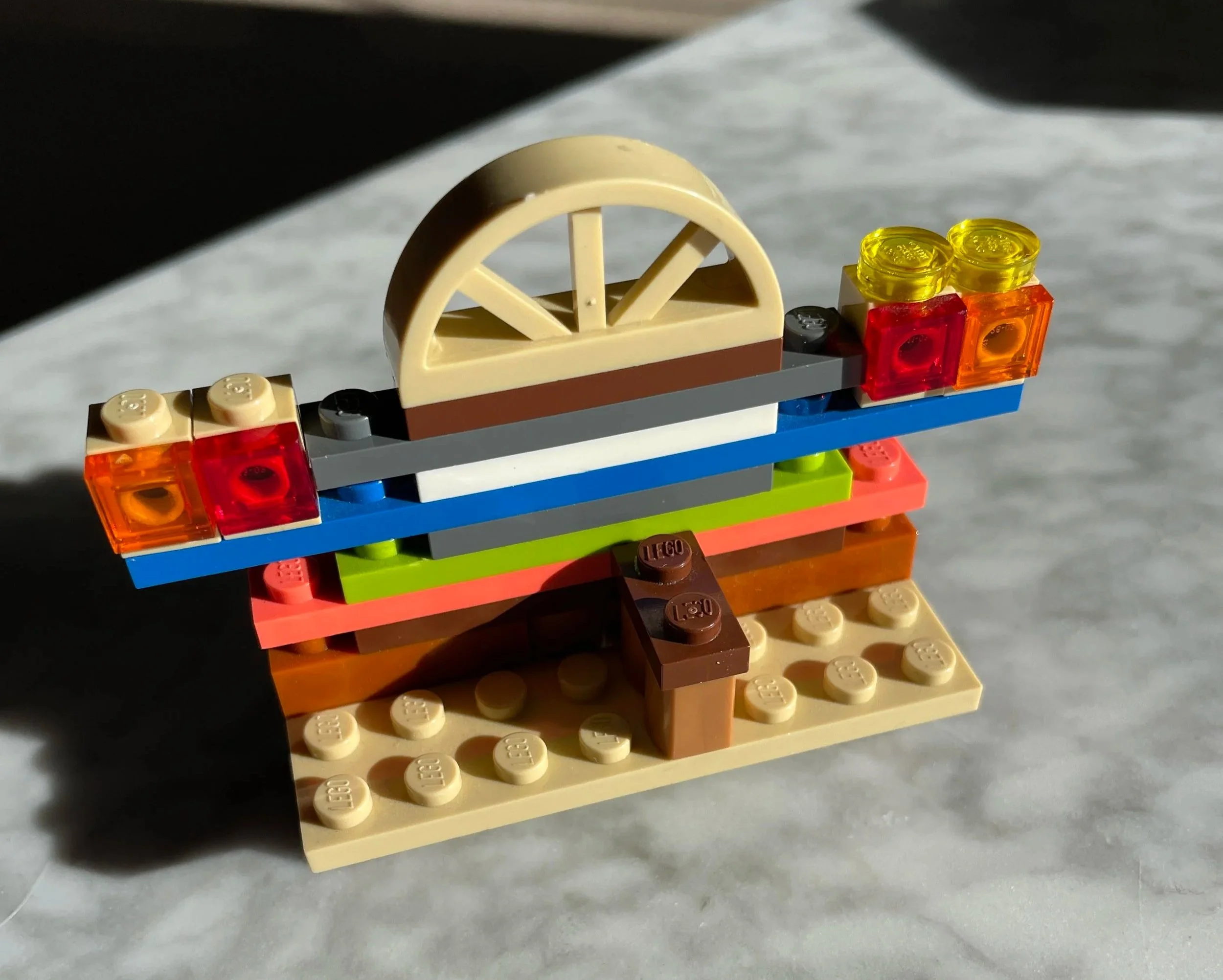
Animism Statue by William Young, age 5
“… we value it not for its usefullness but for its essential being.”
~Dr. Daniel Z. Lieberman, Spellbound
Materialism, on the other hand, tells a different story. It holds that things are nothing more than matter, and that value lies in usefulness and cost. It dominates Western thinking and certainly has both benefits and drawbacks. By the logic of materialism, my animistic Lego statue is worth much less than my dad’s stolen laptop. Yet, I’d much rather have to replace the latter as the former seems irreplaceable.
In Spellbound, Dr. Daniel Z. Lieberman writes: “the longer an object is in contact with a human being, the more likely it is to be perceived as living. We value it not for its usefulness but for its essential being. It is almost as if human minds radiate soul the way our bodies radiate heat”. This is exactly why those ornaments and the Lego statue matter more than the laptops. They hold years of family love and memory.
. . .
As I pulled away from the airport, dawn broke. The sky turned into an upside-down ocean, bright orange waves edged with royal purple. I found myself swimming in gratitude for the legacy of my parents’ love and the material things we have that imbue it. I was also awestruck by that sunrise!
I wish accountability for the people who stole our things and I hope that the accountability can be a vehicle to bring about change in their lives. More than anything, I wish they could feel the embrace I felt in that moment, held by both my parents’ love and the beauty of the sky. If they only receive this love because it emanates from our belongings that are now in their possession, it’s a start.
As many of us enter a season of giving, we wrap presents not only in paper but in intention. If you are like me, some of the gifts are chosen with deep thought and wrapped in love, while others are last-minute Amazon scrambles. Perhaps animism, the idea that meaning is infused through connection with material things, can be a guide post for how we give this year. Because, as this glitch has taught me, it is meaning, not material, that endures.
Your turn:
• What possessions in your life feel infused with soul and wouldn’t be the same if replaced?
• How might you help infuse meaning into your gift giving this year?
• How do you stay open to the unexpected gifts that arise from life’s glitches? Has a canceled flight, a theft, or sudden detour ever led you somewhere important?
Wishing you glorious sunrises and much love,
~Daniela
Founder, The Ōnda Collective
P.S. LOCK YOUR CARS!
P.P.S. Happy 54th wedding anniversary to the one and only Grammie & Boppy (my parents). May everyone feel the extension of your love!

The Current
V1.I8: 12•08•25